
Blog
Office Shredder OEM Red Flags That Add 40% to Your Landed Cost

One in three private-label **office shredder OEM** batches fails a third-party inspection on the first pass. That failure rate routinely adds **40% to landed cost** once you factor in rework, air freight, chargebacks, and dead stock. The glossy catalog means nothing compared to motor duty cycle and production scheduling discipline. This guide exposes the seven traps that quietly destroy margin on **office paper shredder OEM** orders — and shows you how to audit a factory before you wire a deposit.
## 1. Why Motor Duty Cycle Is the First Quality Trap in Office Shredder OEM
Most buyers compare shredders by sheet capacity: 12 sheets, 18 sheets, 25 sheets. That number is marketing, not engineering. The metric that determines whether an office shredder survives high-frequency use is **motor duty cycle** — how long the machine can run before thermal protection shuts it down.
### The “5-Minute Motor” Problem
Budget **office shredder OEM** factories build around low-cost motors rated for **3–5 minutes on, 30+ minutes off**. That works for a home desk, but it collapses in a 30-person office where departments feed paper continuously. The result: the machine overheats mid-batch, users jam it, and your brand eats negative reviews.
### What a Commercial High-Power Motor Should Deliver
A dependable **office paper shredder OEM** supplier should offer a **commercial high-power motor** rated for **continuous operation of 30–60 minutes** without overheating shutdown. Look for three engineering signals in the spec sheet:
– **Thermal overload protection** that resets automatically (not a one-time fuse).
– **Copper-wound motor**, not aluminum-wound.
– **Duty cycle stated in minutes**, never vague phrases like “long run time.”
Industry audits show motors with a stated **continuous-run rating of at least 30 minutes** cut field return rates by **25–35%** compared with budget motors rated under 10 minutes.
### Request the Motor Test Video Before Sampling
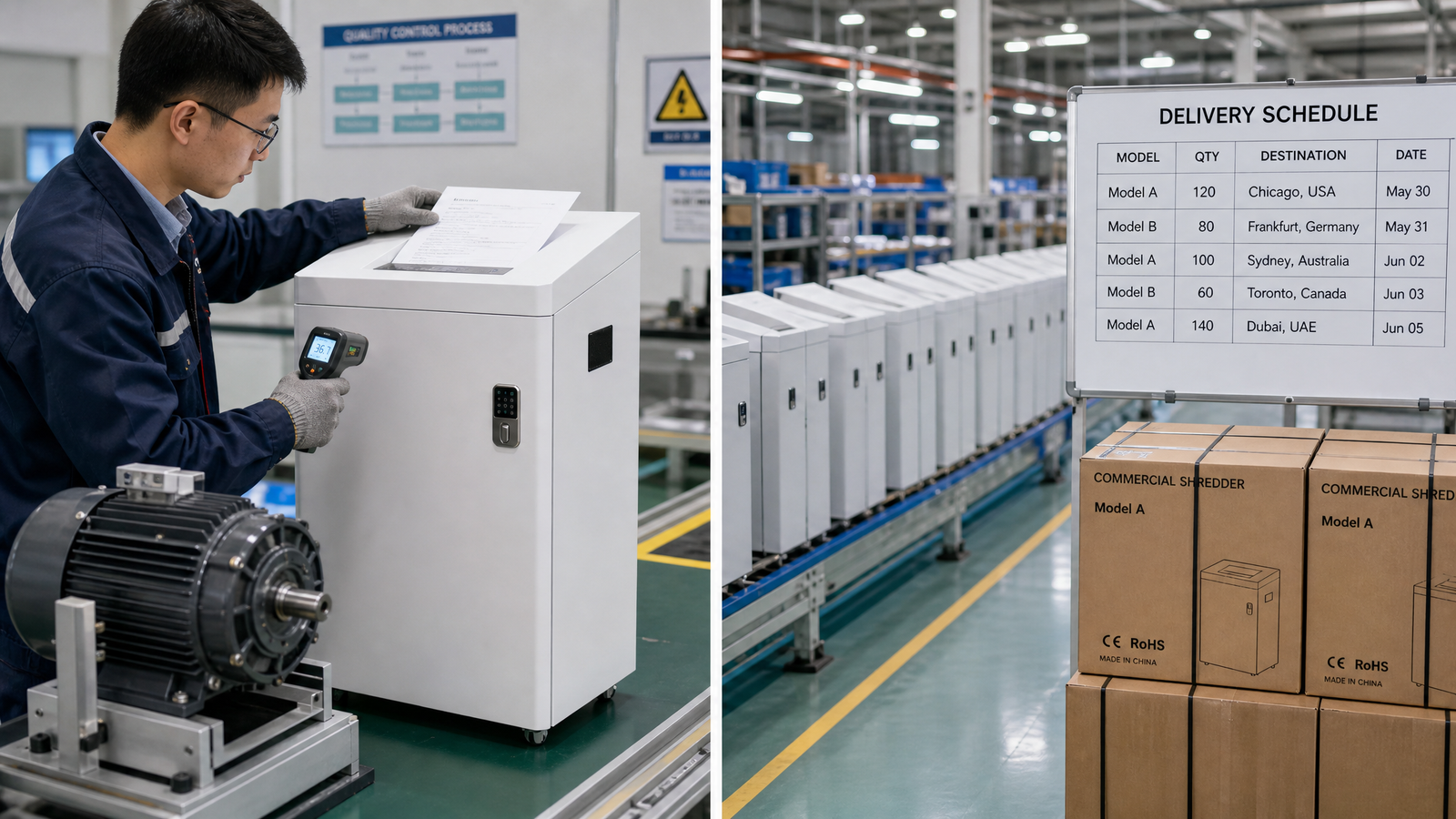
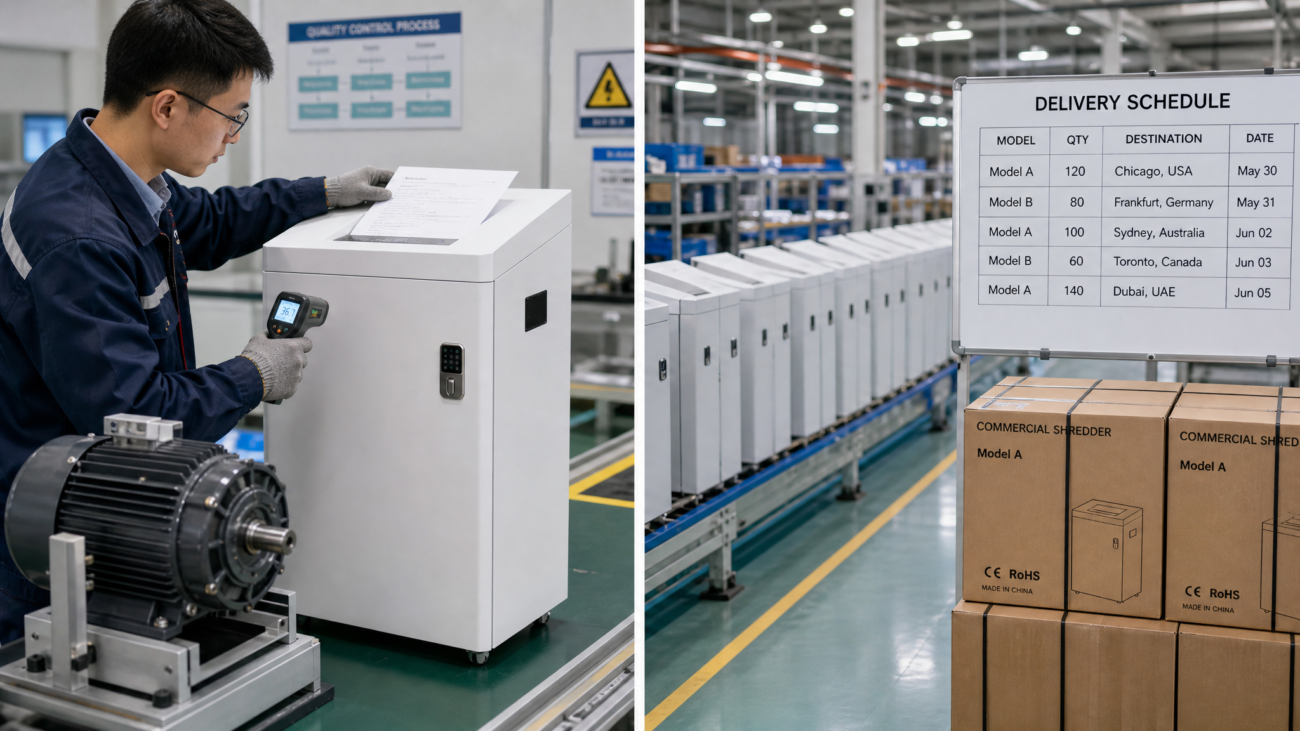
Ask the factory to film a **continuous-run test**: the shredder running 30 minutes at 80% load with a temperature-gun reading on the motor housing. Reliable **shredder OEM** partners send this video within 48 hours. A factory that refuses — or sends a 90-second clip — is showing you the red flag before you pay.
## 2. Delivery Time Red Flags That Destroy Your Seasonal Sales Window
A **shredder OEM** that ships 45 days late costs you more than the invoice. You lose the back-to-school surge, the January office-budget refresh, and the Q4 procurement cycle. Late delivery is a margin killer, not just an inconvenience.
### Vague Lead Times Are a Contractual Warning
When a sales rep says “about 30 to 45 days,” ask for a **week-by-week production schedule** before signing. Trustworthy **office shredder OEM** factories can break the order into:
– **Week 1:** material reservation and motor procurement.
– **Week 2–3:** injection molding and blade machining.
– **Week 4:** assembly and inline QC.
– **Week 5:** final audit and packing.
If they cannot produce this schedule, they likely do not control their own supply chain.
### The “Photo Proof” Test
During production, request **three dated photos** of your actual batch: raw motor inventory, first-off assembly, and finished cartons. A factory that sends generic marketing photos or “forgets” twice is already behind schedule.
### Build Buffer Into the Contract, Not Just the Calendar
Experienced importers add a **10–15% buffer** to quoted lead times for **office shredder OEM** orders around Chinese New Year, Golden Week, and peak ocean freight season. Better yet, write a **late-delivery penalty clause**: 0.5–1% of order value per week of delay, capped at 5–10%.
## 3. Hidden Cost Traps: MOQ, Tooling, and “Free” Sample Math
The quoted unit price on an **office shredder OEM** deal is rarely the final cost. Three hidden traps inflate your real landed cost.
### The MOQ Trap
A factory quoting **1,000 units per model** protects its own production efficiency, not your cash flow. Unless you need a fully custom housing, a solid **office paper shredder OEM** should accept **300–500 units per model** with standard tooling and neutral packaging. Pushing for a low MOQ without understanding tooling just shifts cost elsewhere.
### Tooling Fees That Never Die
Custom logos, brand colors, and unique housings require tooling. Standard practice: **the factory owns the mold and the buyer amortizes the fee over the first order**. Some factories then add a “mold maintenance fee” on every reorder. To avoid costly chargebacks, get tooling ownership and maintenance terms in writing before the first payment.
### The “Free Sample” That Costs $600
A “free” sample usually means the unit is free, but you pay:
– **Express freight:** $80–$150.
– **Custom branding setup:** $50–$100.
– **Certification document copies:** $100–$300.
A serious **shredder OEM** buyer budgets **$500–$800** for two fully branded, tested samples. If a supplier wants $2,000+ for a single sample, keep shopping.
## 4. How to Audit an Office Shredder OEM Before You Pay a Deposit
Due diligence separates profitable private labels from 40% cost overruns on **office shredder OEM** orders. A structured audit takes 5–7 days and costs far less than one botched shipment.
### Request These 5 Documents First
Before considering a deposit, demand:
1. **Business license and export registration.**
2. **Motor supplier certificate** naming the actual motor brand.
3. **Third-party test reports** (CE, UL, RoHS, REACH where relevant).
4. **Production capacity statement** with monthly unit output.
5. **Two reference importers** you can contact directly.
A factory that hesitates on item 2 is almost certainly hiding a budget motor.
### Send a Third-Party Inspector for Motor and Blade Checks
A **$300–$500 pre-shipment inspection** catches most defects in **office shredder OEM** orders before containers leave port. Instruct the inspector to test:
– **Continuous-run time** until thermal shutdown.
– **Blade hardness** and paper-feeding consistency.
– **Safety features:** auto-reverse, overheat indicator, bin-full sensor.
– **Noise level** under load (offices tolerate ≤ 65–68 dB).
### Audit the Warranty Logic
Reliable manufacturers typically offer **12–24 months** on commercial shredder motors. If the warranty is only 6 months or excludes the motor entirely, the factory does not trust its own product — and neither should you.
## 5. Building a Supply Contract That Protects Quality and Delivery
A handshake does not survive a missed season. Your **office shredder OEM** contract should convert every promise into a measurable obligation.
### Define Quality in Numbers
Never accept “good quality” as a specification. The contract should state:
– **Motor duty cycle:** minimum 30 minutes continuous run.
– **Sheet capacity:** at 70 gsm paper, not 60 gsm.
– **Safety certifications** with certificate numbers.
– **Acceptable defect rate:** below 1.5% AQL 2.5 on critical defects.
### Tie Payment Terms to Milestones
Use **30/70 or 20/80 terms**: deposit to reserve materials, balance against a **passing inspection report and bill of lading**. This keeps the factory motivated through the final QC gate.
### Write the Penalty and Rework Clause
Specify who pays for rework when an inspection fails: the **factory pays for repair and re-inspection**, and the buyer can cancel with refund if defects exceed the AQL threshold twice. This one clause converts vague promises into enforceable delivery dates for every **office paper shredder OEM** order.
## Conclusion: Your 3-Step Audit Before the Next Office Shredder OEM Order
The difference between a profitable shredder line and a 40% cost overrun comes down to three checks:
1. **Verify the motor duty cycle** — demand a continuous-run test of 30+ minutes and copper-wound motor specs.
2. **Lock delivery dates contractually** — get a week-by-week schedule, photo proof, and a late-delivery penalty.
3. **Expose hidden costs** — pin down MOQ, tooling ownership, and sample fees in writing before the deposit.
**Use this checklist to audit your current office shredder OEM supplier this week.** Request the motor test video, the production schedule, and the five documents above. If any answer is vague, walk away — your landed cost depends on it.
—
## 📚 Related Resources
Use these internal links to strengthen the topic cluster:
– Anchor: Office Shredder Motor Duty Cycle Explained → /office-shredder-motor-duty-cycle
– Anchor: How to Read a Shredder QC Inspection Report → /shredder-qc-inspection-report
– Anchor: OEM vs ODM Shredder: Which Is Right for Your Brand? → /oem-vs-odm-shredder
– Anchor: Master Carton & Packaging Requirements for Shredder Imports → /shredder-packaging-import-requirements
—
## ❓ Frequently Asked Questions
**Q:** What motor duty cycle should a commercial office shredder OEM offer?
**A:** Look for a minimum continuous-run rating of 30–60 minutes with a high-power, copper-wound motor and automatic thermal overload protection. Motors rated for only 3–5 minutes of continuous use will overheat and shut down in high-frequency office environments.
**Q:** What is a typical MOQ for office paper shredder OEM private label orders?
**A:** Most factories quote 500–1,000 units per model, but a quality supplier will usually accept 300–500 units per model when you use standard tooling and neutral packaging. Custom housings and brand-specific tooling typically raise the MOQ.
**Q:** How long does office shredder OEM production and shipping take?
**A:** Expect 25–45 days for production plus 15–30 days for ocean freight. Air freight shortens transit to 5–7 days but sharply raises landed cost. Always add a 10–15% buffer around Chinese New Year and peak shipping season.
**Q:** What are the biggest red flags that a shredder supplier will miss delivery dates?
**A:** Vague lead times like “about 30–45 days,” refusal to share a week-by-week production schedule, generic photos instead of dated batch photos, and no late-delivery penalty clause in the contract.
**Q:** Is a third-party pre-shipment inspection worth it for office shredder OEM orders?
**A:** Yes. A $300–$500 inspection typically catches most motor, blade, and safety defects before shipping and can prevent rework, chargebacks, and dead stock that add 40% or more to landed cost.


