
Blog
7 Costly Red Flags to Avoid When Choosing a High-Security Commercial Shredder Supplier

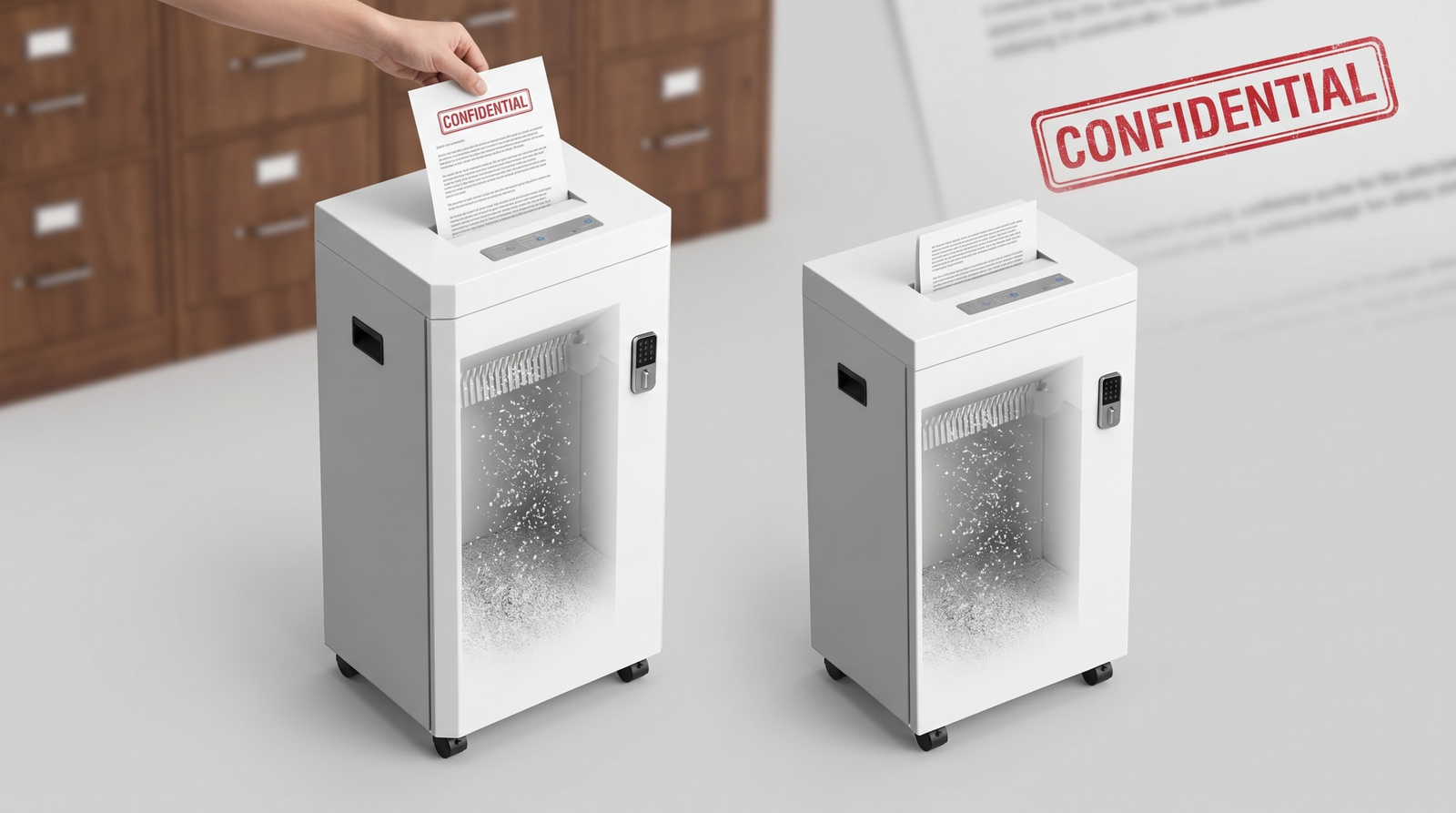
The average data breach now costs $4.88 million, yet forensic investigators still rebuild “destroyed” documents from strip-cut shredder waste in under an hour. Paper remains one of the top three overlooked leak vectors in government, law firm, and finance operations. A high-security commercial shredder with P-4 or P-5 particle output is the only reliable line of defense.
The problem? Most buyers assume “commercial” automatically means “secure.” It doesn’t. Supplier mislabeling, hidden MOQ traps, and undersized duty cycles turn a routine purchase into a compliance liability that can trigger failed audits and costly chargebacks.
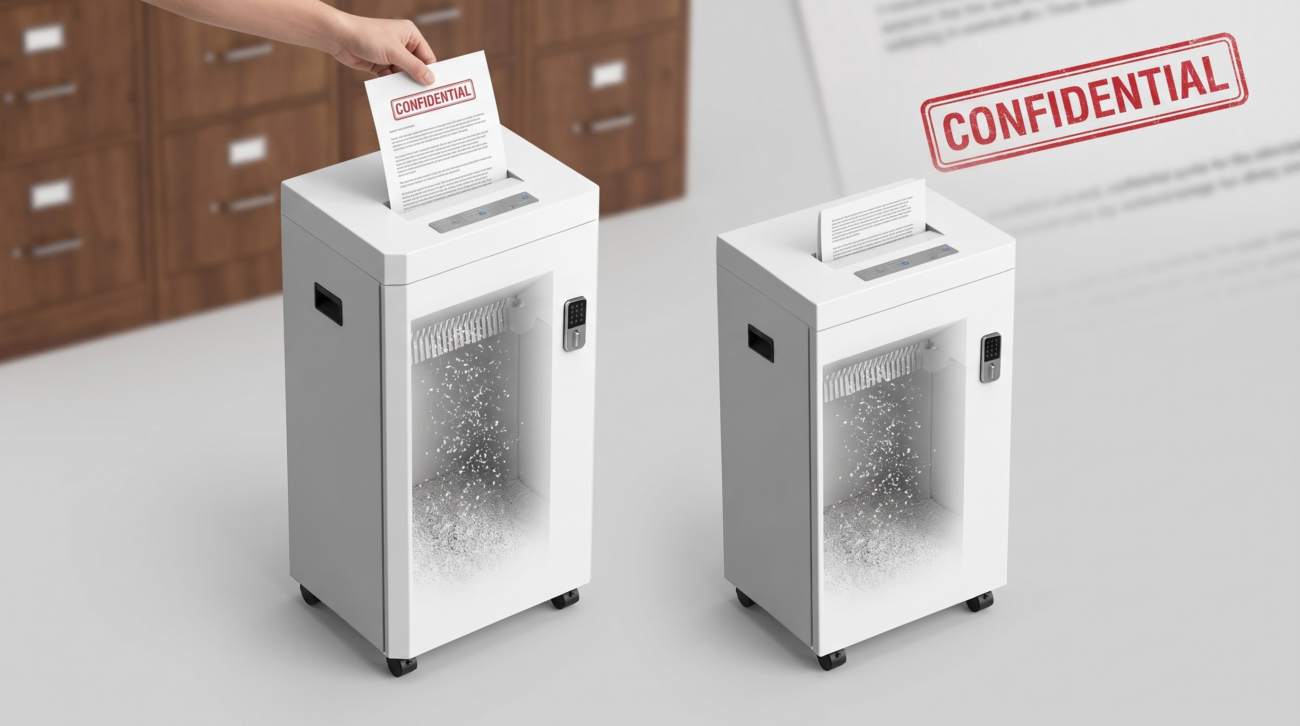
What P-4 and P-5 Security Levels Actually Mean (DIN 66399)
P-4 cross-cut shredding produces particles no larger than 4 x 40 mm, with a maximum particle area of 160 mm². That meets confidential-document destruction for HR files, contracts, and client records.
P-5 micro-cut shredding tightens output to 2 x 15 mm, with a maximum particle area of just 30 mm². This is the minimum many law firms and government agencies require for sensitive or classified-adjacent material.
Reliable manufacturers publish the particle area, not just the level label. A machine claiming “P-5” without a lab certificate is already a red flag.
7 Supplier Red Flags That Expose Confidential Documents
Red Flag #1: Vague or Unverifiable P-4/P-5 Certifications
A genuine high-security commercial shredder carries a DIN 66399 test certificate stating the exact particle size. Suppliers that only say “high security” or “cross-cut” often ship strip-cut machines. Ask for the certificate number and verify it with the issuing lab before requesting a quote.
Red Flag #2: Hidden Minimum Order Quantity (MOQ) Traps
Low advertised unit prices frequently hide an MOQ that forces you to buy 50–200 units. Industry audits show that inflated MOQ contracts waste 18–32% of procurement budgets. Request the landed cost per unit at your actual volume, including freight and import duties.
Red Flag #3: Undersized Duty Cycle and Motor Power
A P-4 or P-5 shredder that runs 5 minutes and rests 30 minutes cannot support a busy finance department. Check continuous runtime and sheets-per-pass rating. Reliable manufacturers typically state duty cycles of 30–60 minutes for commercial-grade motors above 200 watts.
Red Flag #4: Missing Third-Party Destruction Test Results
Ask for a lab video or test report showing shredded output under magnification. Without it, you cannot prove “unrecoverable after shredding” in a compliance audit. Government and law firm buyers should require this documentation in the RFQ.
Red Flag #5: Bait-and-Switch Pricing on Blades, Oil, and Service
The purchase price is only 40–55% of the total cost of ownership. Cross-cut blades wear faster than strip-cut blades. Compare blade replacement costs, lubrication schedules, and warranty labor rates before signing a multi-year agreement.
Red Flag #6: Ignoring Government, Law Firm, and Finance Compliance Needs
A supplier that cannot map its shredder to your compliance standard—GLBA for finance, HIPAA for healthcare-adjacent records, or agency retention policies—adds legal risk. High-security commercial shredders for law firms should also offer a certificate-of-destruction workflow option.
Red Flag #7: No Transparent TCO (Total Cost of Ownership) Data
Suppliers that hide energy consumption, oil sachets, bag costs, and service fees are pricing on a false economy. Request a five-year TCO worksheet. Reliable manufacturers typically provide blade life ratings of 5,000–8,000 sheets for P-4 and 3,500–5,000 sheets for P-5.
How to Audit a High-Security Commercial Shredder Supplier in 4 Steps
- Verify the DIN 66399 certificate and cross-check the lab name.
- Request a live demo with your own mixed media—staples, credit cards, and CDs.
- Compare five-year TCO, not just the unit price.
- Confirm warranty terms: at least 2 years on cutting heads for commercial use.
Use this checklist to audit your current supplier before your next reorder. To avoid costly chargebacks, document every certification claim in the purchase contract.
Maintenance and Compliance Best Practices for P-4/P-5 Shredders
Even a certified P-5 machine loses security if you skip oiling. Run lubricant sheets after every 30 minutes of use or every full bin. Schedule blade inspections quarterly and keep a destruction log with date, operator, and batch ID for audit trails.
Industry audits show that well-maintained high-security commercial shredders last 7–10 years, while neglected units fail in under 3 years. A maintenance contract covering blade replacement is usually cheaper than a full replacement unit.
Conclusion: 3 Takeaways Before You Buy
- P-4 (4 x 40 mm) and P-5 (2 x 15 mm) particle sizes are non-negotiable for confidential destruction—demand lab certificates.
- Hidden MOQ, duty cycle, and TCO traps cause more waste than the shredder’s sticker price.
- Supplier transparency on testing, maintenance, and compliance workflow separates reliable manufacturers from risky vendors.
Your next step: use this 7-point checklist to audit your current supplier, and request a DIN 66399 certificate and five-year TCO worksheet before you approve any new purchase order.


